
You can love someone, trust them, feel attracted to them, and still feel uncomfortable being naked in front of them.
Maybe you change clothes with your back turned. Maybe you prefer the lights off. Maybe you keep a shirt on longer than necessary, pull the covers over yourself, or instinctively reach for a towel when getting out of the shower.
You might even feel perfectly comfortable with your partner seeing you in certain circumstances, but become intensely self-conscious when you feel as though your body is being looked at.
And that can be confusing.
Why should something as ordinary as being naked with someone you love feel so vulnerable?
For many women, the answer has less to do with their partner and more to do with the relationship they’ve developed with their own bodies.

Being Naked Can Feel Like Being Evaluated
There’s a difference between someone seeing your body and feeling as though your body is being evaluated.
When you’re getting dressed, you may be focused on what you’re wearing. When you’re at the beach, you may be aware of how your swimsuit fits. But when you’re naked, there is very little between you and the person looking at you.
For someone who feels uncomfortable with her appearance, that can create a sense of exposure that goes beyond physical nakedness.
You might become acutely aware of your stomach, breasts, thighs, skin, or other features you wish were different. Instead of being present with your partner, you find yourself wondering what they see.
Are they noticing my stomach? Do they think I’ve gained weight? Do they still find me attractive?
The experience can become less about intimacy and more about monitoring your own appearance.
This is one way body image can affect everyday experiences. When we’re preoccupied with how our bodies look, even moments that might otherwise feel natural and enjoyable can become opportunities for self-criticism.
You May Have Learned to Treat Your Body as Something to Hide
Many women grow up receiving messages about what their bodies should look like, which parts are acceptable to show, and which parts should be concealed.
Some of those messages are explicit. Others are absorbed through jokes, criticism, comparisons, comments about weight, or the way adults around us talk about their own bodies.
Over time, we can begin to view our bodies as something that needs to be managed.
We learn to stand a certain way in photographs. We choose clothes that conceal particular areas. We become skilled at adjusting, covering, and positioning ourselves so that other people see what we consider our best angles.
Eventually, those habits can follow us into private spaces.
Even with a partner who has never criticized our appearance, we may still feel the need to hide the parts of ourselves we’ve been taught to dislike.
Understanding how body image develops and the experiences that shape how we see ourselves can help explain why these feelings don’t necessarily disappear simply because we’re in a loving relationship.
Our beliefs about our bodies are often much older than our current relationships.

Why Compliments Don’t Always Make the Insecurity Go Away
You might have a partner who regularly tells you that you’re beautiful. They may express attraction, initiate affection, and make it clear that they enjoy seeing you.
And yet, you still feel uncomfortable.
This can be frustrating for both people. Your partner may not understand why reassurance isn’t enough, while you may feel guilty for struggling with something they believe they’ve already addressed.
But compliments don’t automatically change the way we see ourselves.
If you’ve spent years believing that your body is unattractive, undesirable, or somehow inadequate, hearing someone tell you otherwise may not immediately feel believable.
You might even find yourself questioning the compliment.
Are they just being nice? Are they saying that because they love me? Do they actually mean it?
The problem isn’t necessarily a lack of reassurance. It may be that you’ve developed a deeply ingrained way of evaluating your appearance that doesn’t easily accommodate a different perspective.
You can appreciate your partner’s affection without being able to absorb every compliment.
And you don’t have to feel guilty about that.
Intimacy Can Make Body Image Feel More Complicated
Being naked with someone can involve a level of vulnerability that isn’t present in most other situations.
You’re not just allowing someone to see your body. You’re allowing yourself to be seen in a moment when you may feel especially exposed.
That can be difficult when you’re accustomed to controlling how other people see you.
You might worry about how your body looks from a particular angle. You may feel distracted by changes in your appearance or become uncomfortable when your partner touches an area you’re self-conscious about.
Sometimes, the internal commentary becomes so persistent that it interrupts your ability to enjoy the experience.
Instead of being present, you’re mentally stepping outside yourself and imagining how you appear to someone else.
This is sometimes described as self-objectification: viewing yourself from an outside perspective and evaluating your appearance rather than experiencing yourself from within.
It can be exhausting to feel as though you’re both participating in an intimate moment and simultaneously watching yourself participate in it.

What If Your Body Has Changed Since the Relationship Began?
For some women, this discomfort develops or intensifies over time.
Perhaps your body has changed after pregnancy, weight fluctuations, illness, aging, or other life experiences. Maybe you felt more comfortable with your appearance earlier in the relationship and now feel less certain of yourself.
There can be an added layer of vulnerability when your partner remembers your body looking different.
You may wonder whether they notice the changes as much as you do. You might compare your current appearance to old photographs or remember how you felt when you first met.
It’s important to recognize that these feelings can exist even when your partner is loving and accepting.
You don’t have to be experiencing rejection to feel insecure. Sometimes the comparison is happening entirely within your own mind.
And if you’re struggling with the difference between your current body and the one you remember, you may relate to why we miss the bodies we had when we were younger.
Our bodies change, but our expectations of ourselves don’t always change at the same pace.
You Don’t Have to Force Yourself to Become Comfortable
If being naked makes you uncomfortable, the answer isn’t necessarily to force yourself into situations that feel exposing.
You don’t owe anyone a performance of confidence. You don’t have to suddenly abandon every habit that makes you feel secure.
Instead, it may help to become curious about what is happening.
Are you uncomfortable because of something your partner has said or done? Are there particular parts of your body that trigger self-consciousness? Do you feel uncomfortable being seen in general, or does the discomfort appear specifically during intimacy?
Those distinctions matter.
If your partner has made hurtful comments about your appearance, dismissed your boundaries, or made you feel unsafe, that’s a relationship issue that deserves to be addressed. You shouldn’t be expected to solve it by changing your body image.
But if your partner is loving and accepting and you still struggle to feel comfortable, you may be dealing with beliefs about your appearance that deserve attention in their own right.
You can start with small changes that feel manageable. Perhaps that means allowing yourself to change clothes without rushing, being less deliberate about hiding certain parts of your body, or noticing when your thoughts shift from experiencing a moment to evaluating how you look.
The goal isn’t to force yourself to be comfortable overnight. It’s to understand what makes being seen feel so difficult.
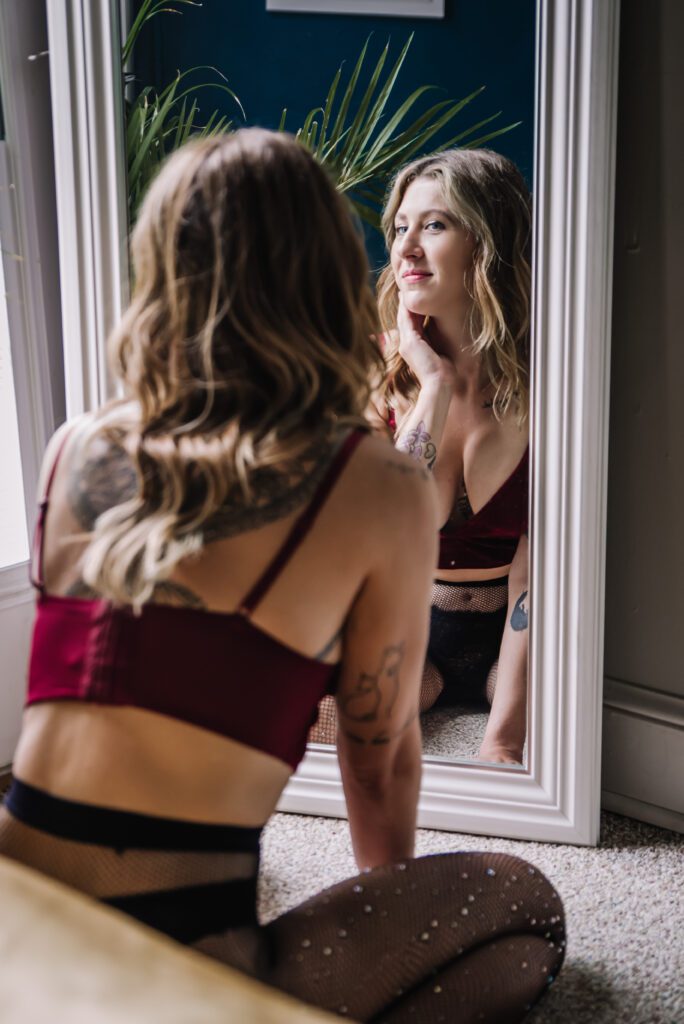
What Would It Mean to Feel at Home in Your Body?
There’s a difference between wanting someone to find your body attractive and feeling comfortable inhabiting it yourself.
Of course, it’s natural to want to feel desired by your partner. Physical attraction can be a meaningful part of a relationship.
But it can become difficult when your ability to enjoy intimacy depends on whether you believe you look good enough in that particular moment.
What if you didn’t have to monitor your stomach? What if you didn’t feel compelled to hide every perceived imperfection? What if being naked could simply be an ordinary part of being close to someone?
You don’t have to love every feature of your body to experience intimacy. You don’t have to feel beautiful every day. And you certainly don’t have to meet some imaginary standard of physical perfection before you deserve affection.
Your body is not an obstacle standing between you and intimacy.
It’s part of you.
And perhaps the most meaningful shift isn’t learning to love every inch of your appearance. It’s gradually learning that you are allowed to be present, comfortable, and connected without constantly evaluating how you look.
You deserve to experience intimacy as a participant, not as a critic standing outside yourself.


